The garage door maintenance list, written for a garage that hits 115 degrees
A door in Austin cycles more in summer, bakes under a west-facing roof, and collects limestone dust from every road cut and foundation pour in the subdivision. Twenty minutes twice a year keeps it quiet and keeps the spring from surprising you. Here is the list, what to use, and what to leave alone.
The seasonal calendar
| When | Do | Why then |
|---|---|---|
| March or April | Lubricate rollers, hinges, bearings and the spring; wipe the photo-eyes; run the balance and reverse tests | Before the heat, so fresh lubricant is on everything when the garage starts cooking |
| June | Check the opener's light bulbs and the remote batteries; listen for new noise | The first hot weeks are when thin grease and tired capacitors show up |
| September or October | Repeat the lubrication and tests; replace the bottom seal if it's cracked or flattened | Summer dust has turned spring lubricant to paste, and the seal has a winter to get through |
| Before a freeze | Clear the slab under the door; make sure the seal isn't sitting in water | A seal frozen to the slab plus an opener pulling up is how bottom sections tear |
| After any big storm | Look at the opener's light, test the remote, check the sensors | Surges don't always announce themselves; a dim light is an early sign |
Lubricate the right parts with the right stuff
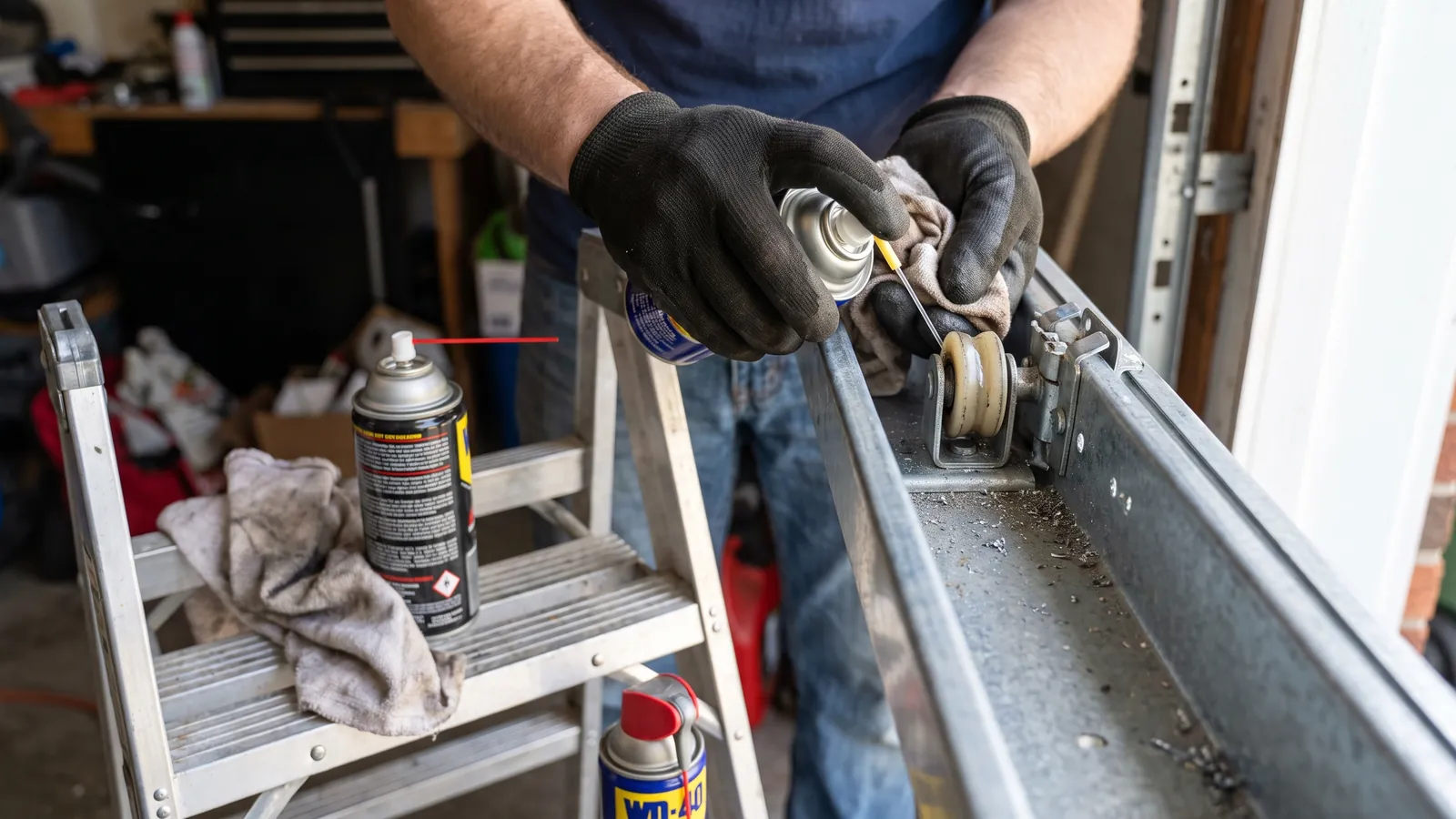
Use a lithium or silicone spray made for garage doors, never WD-40 as a lubricant (it's a solvent; it cleans and then it evaporates, leaving less than you started with) and never grease, which collects limestone dust and turns into a grinding paste. In a hot garage, a dry PTFE spray on the rollers holds up better than anything wet. With the door down and the opener unplugged:
- Roller bearings, a short burst into each roller where the stem meets the wheel. Nylon rollers with sealed bearings need none; steel rollers need it every six months.
- Hinges, at the pivot pins, all of them, including the top and bottom brackets.
- The torsion spring, a light coat along the coils to slow rust. Wipe off the excess so it doesn't drip on the car.
- The end bearing plates and the centre bearing on the shaft.
- The opener rail, a thin film on a chain or screw drive; a belt drive needs nothing on the belt.
Don't lubricate the tracks. Rollers roll in a dry track; a greased track collects grit and makes the door slide instead of roll. Wipe the inside of the tracks with a rag and a little solvent instead.
The balance test
Pull the red release cord with the door down to disconnect the opener. Lift the door by hand to about waist height and let go. A balanced door stays put or drifts an inch. A door that falls has tired springs; a door that rises has springs wound too tight. Either way the opener has been doing work it wasn't built for, and that is how gears strip. Re-engage the opener by pulling the cord toward the door or running the opener until the trolley clicks in. If the door is badly out of balance, stop there and call; adjusting springs is not a homeowner job.
Look, listen, touch
- Cables: look at both, from the drums at the top down to the bottom brackets. Fraying, rust or a kink means replacement, $160 to $320 the pair. Don't touch the bottom brackets; they're under spring tension.
- Rollers: cracked nylon, wobbling wheels, a stem worn thin. A set of ten sealed-bearing nylon rollers, $150 to $300, is the single best noise fix on a door.
- Hinges: cracked, or a loose pin, usually the number 1 and 2 hinges at the bottom. Tighten the lag screws into the door; replace a cracked hinge.
- Bottom seal: flattened, cracked, or daylight under the door. The rubber bulb slides out of its retainer; $90 to $190 installed, or a DIY part.
- Weatherstrip around the opening: the vinyl stop moulding cracks in the sun. It's a trim job, not a door job.
- Noise: a squeal is dry rollers; a rattle is loose hardware; a grinding is the opener's gear; a pop on the way up is a roller or a hinge.
The opener's part
Wipe the photo-eye lenses, check both lights are steady, and run the reverse test described in the safety guide. Change the remote and keypad batteries yearly; change the backup battery in the head unit when it beeps, about every three to five years. Replace the opener's light bulbs with ones marked compatible with garage door openers, because some LEDs interfere with the remote's radio.
Leave these alone
Never: adjust, wind or remove a torsion spring; remove a cable, drum or bottom bracket; remove a roller from a bottom section; or try to lift a door with a broken spring. Those parts are under enough tension to break bones, and every spring technician has a story. Everything else on this page is yours.
Questions this guide gets asked
How often should a garage door be serviced?
Twice a year by you, as above, and a professional tune-up at $95 to $185 every year or two, where the technician checks the spring tension, the cable condition and the opener force settings with instruments rather than by feel.
What lubricant do you recommend for Austin?
A dry PTFE or silicone spray for rollers and hinges in a hot garage, a light lithium spray on the spring coils. Avoid grease and avoid WD-40 as a lubricant. The can should say garage door on it.
Why does my door squeal in summer and not winter?
Heat thins whatever lubricant is left and dust finishes the job. A spring lubrication in March and again in September usually ends it. If it doesn't, the rollers are worn.
Is a noisy door dangerous?
Not by itself, but noise is the door telling you where the wear is. A door that goes from quiet to loud in a season is worth a look before the part that's complaining fails.
Can I replace rollers myself?
The middle rollers on a torsion-spring door, carefully, yes. The bottom rollers sit in brackets under cable tension and should be left to a technician. On an extension-spring door, leave all of them alone.
Keep reading: Safety reverse test · Repair cost list · Spring replacement cost