The five-minute test every garage door should pass, and what to do if yours doesn't
A garage door is the heaviest moving object in the house, and the opener's reversing system is the only thing between a closing door and whatever is under it. Two tests, five minutes, no tools beyond a scrap of two-by-four. Here is how to run them and how to read the result.
Why the test exists
Since 1993, every residential garage door opener sold in the United States has had to include two independent ways to reverse a closing door: an infrared beam across the opening near the floor, and a force sensor that reverses the door when it meets resistance. Doors have killed children and pets, and still do when the systems aren't working. An opener older than 1993 has neither and should be replaced regardless of how well it runs. Everything newer has both, and both drift out of adjustment over time, which is why the test is yearly and not once.
Test one: the photo-eyes
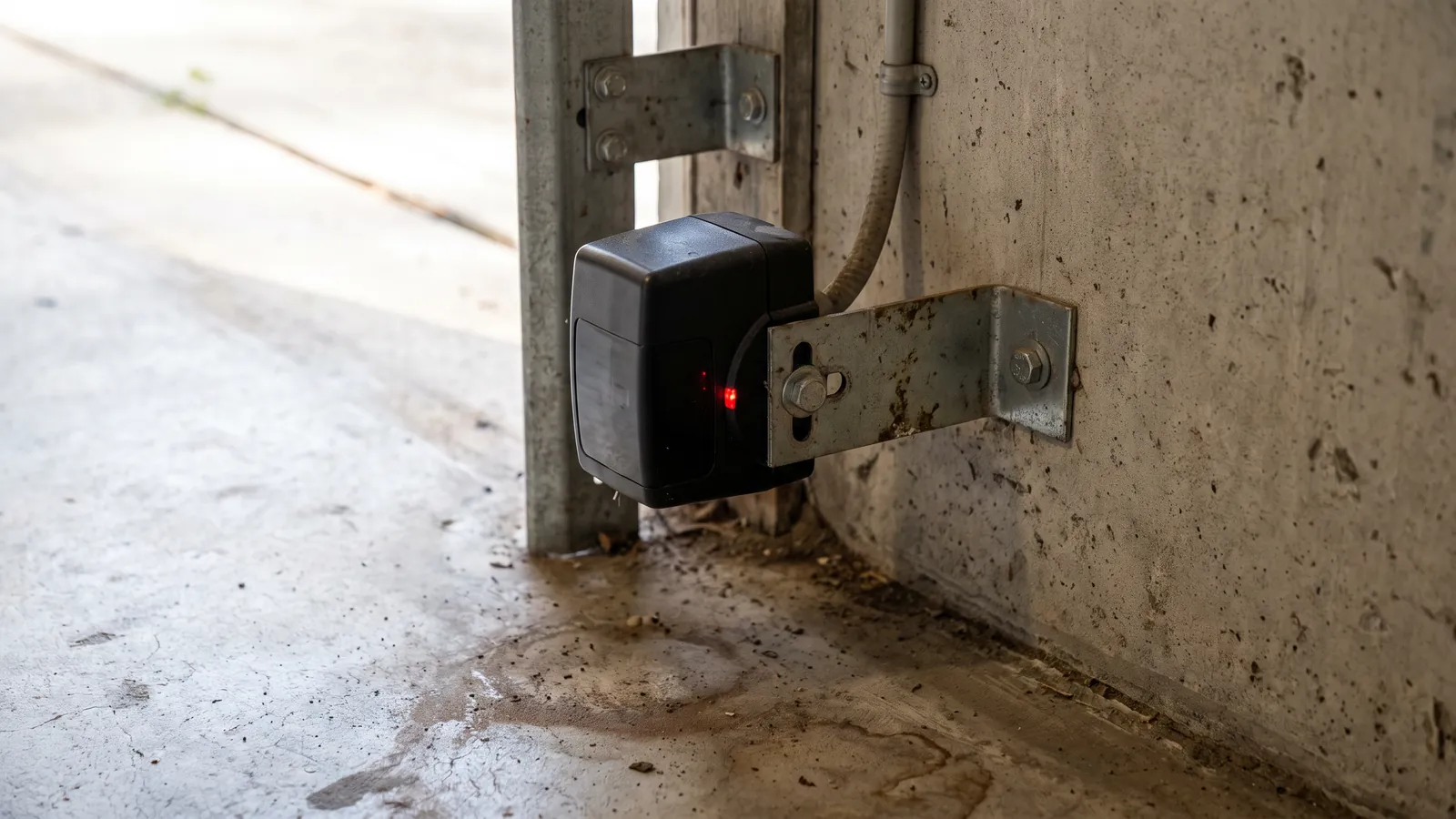
- Find the two small sensors mounted on the tracks near the floor, one each side, no higher than about six inches up. Each has an indicator light. Both should be lit steadily with nothing in the opening.
- Press the wall button to close the door. While it's moving down, wave a broom handle or a cardboard box through the beam between the sensors, below knee height.
- The door should reverse immediately and go back up. If it keeps closing, the photo-eyes aren't working; stop using the opener until they are.
A sensor light that blinks or is off with nothing in the beam means the pair is out of line or a lens is dirty. Wipe the lenses, check that both brackets point straight across at each other, and look for a cobweb or a leaf. On a west-facing door in Austin, low sun in December and January can shine straight into a sensor and blind it for an hour in the afternoon; a short cardboard shade over the lens solves it. A sensor that stays faulted after that has a wiring break or has failed; a pair is $110 to $220 installed.
Test two: the two-by-four
- Lay a two-by-four flat on the floor in the middle of the opening, under the path of the door.
- Press the wall button to close. The door should come down, touch the board, and reverse within about two seconds.
- If the door stops and sits on the board without reversing, or pushes down on it, the down-force setting is too high or the force sensor has failed. Stop using the opener until it's adjusted.
The force setting is a dial or a button sequence on the head unit, and the owner's manual explains it for your model. The principle: set the force low enough that the door reverses on the board, high enough that it closes fully without reversing on its own. If you can't find a setting that does both, the door is binding somewhere or is out of balance, and the opener is being asked to push through a problem. That's a technician visit.
Test three, while you're there: the balance
With the door down, pull the release cord to disconnect the opener, lift the door by hand to waist height and let go. It should stay. A door that drops has weak springs and is dangerous to work under; a door that shoots up is over-wound. A badly unbalanced door will often fail the two-by-four test because the opener is masking a spring problem with force, and turning the force down just makes the door stop halfway. Fix the springs, then re-test.
What a fail means, and who fixes it
Photo-eyes don't reverse the door
Clean and align first. If the lights won't go steady, a wire has broken or a sensor has died. Technician, $110 to $220 for the pair.
Door doesn't reverse on the board
Force setting too high or the sensor in the opener has failed. Adjust per the manual; if adjustment doesn't work, the opener needs a technician or, if it's old, replacing.
Door won't close at all after adjusting
Force too low, or the door is binding in the track. Check for a roller out of place or a bent track section; don't keep raising the force to overcome it.
Door fails the balance test
Springs. Not a homeowner job. The opener should never be lifting a door the springs can't hold; fix the balance before anything else.
Opener predates 1993 or has no photo-eyes
Replace it. Nothing about an old opener is worth the risk, and a new belt drive with battery backup is $650 to $1,050 installed.
Everything passes
Write the date on a piece of tape on the head unit and do it again next year. You're done.
Keeping people clear
Mount the wall button at least five feet off the floor so small children can't reach it, and keep remotes out of toy boxes. Teach kids that the door is not a ride and the opening is not a finish line. Keep the release cord's red handle where an adult can reach it from inside the garage with the door down. None of this replaces the tests; it's what the tests protect.
Questions this guide gets asked
How often should I run the reverse test?
Once a year at minimum, and after any work on the door or the opener. It takes five minutes and the two-by-four lives in most garages anyway.
My door reverses on the board but very slowly. Is that a pass?
Borderline. It should reverse within about two seconds of contact. A slow reversal usually means the force is set near the top of its range to overcome a binding or unbalanced door. Check the balance and the tracks.
The sensors are mounted a foot off the floor. Is that okay?
No. They should be no higher than about six inches so the beam catches a small child or a pet lying in the opening. Lowering them is a simple bracket adjustment; a technician does it in minutes if you'd rather not.
Can I bypass the photo-eyes because they keep faulting?
Please don't. A faulting sensor is telling you about alignment, sun or a wire, all of which are fixable and cheap. Bypassing it removes the protection the law put there.
Does the opener's auto-reverse replace the photo-eyes, or the other way round?
Neither. They're two independent systems that cover different failures: the beam catches something in the opening before the door reaches it; the force sensor catches something the beam missed, like a child's arm above the beam height. Both have to work.
Keep reading: Sensor repair · Maintenance checklist · Opener not working