What a garage door spring replacement costs in Austin, and why the pair is the bargain
Springs are the most-replaced part on any garage door and the one most often sold wrong. The short version: $340 to $580 for a matched pair of torsion springs in the Austin area in 2026, less for extension springs, more for high-cycle. Here is how each option breaks down.
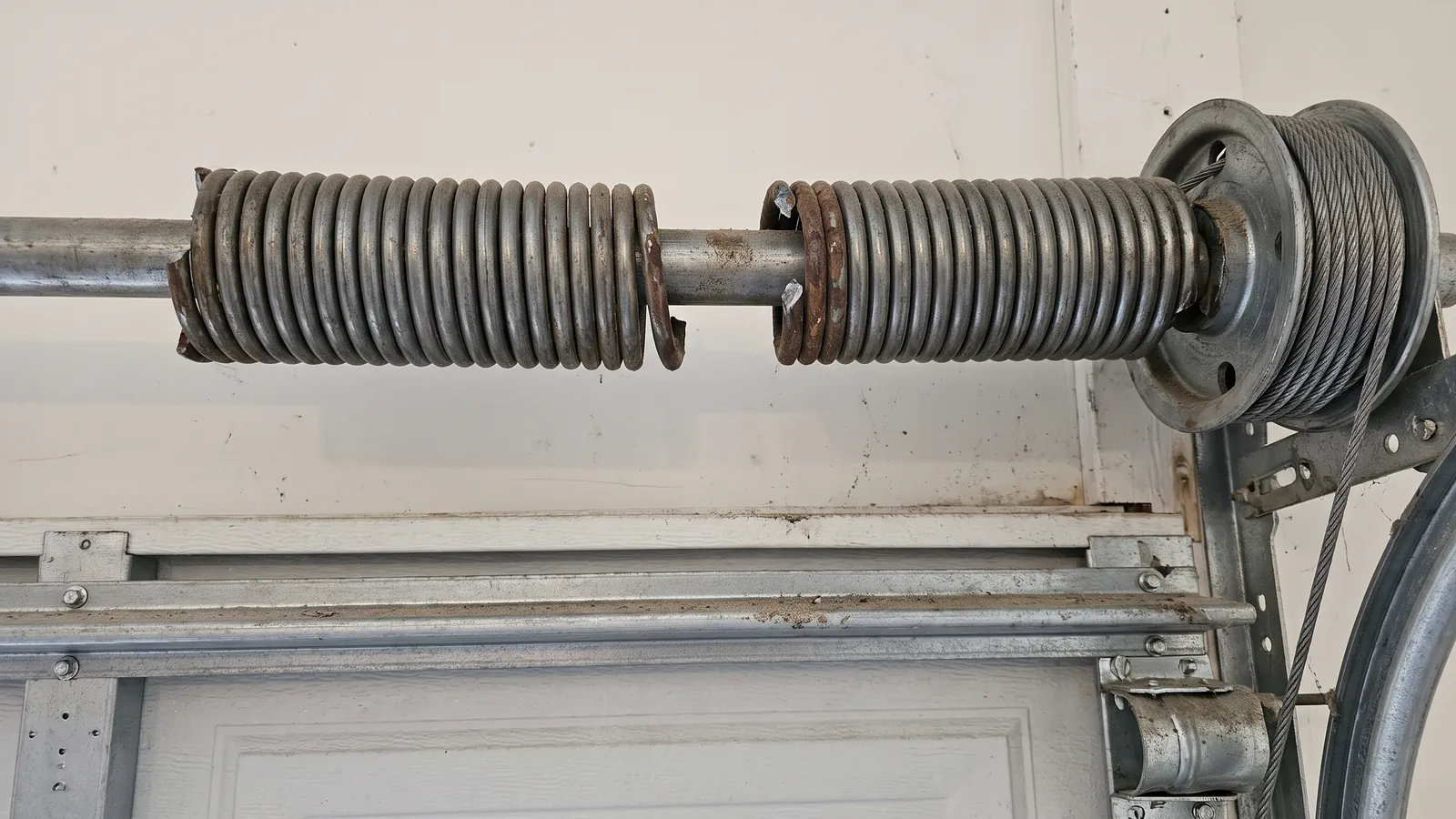
A garage door weighs between ninety and two hundred and fifty pounds, and the opener is built to move about ten percent of that. The springs do the rest. When one breaks, the door becomes dead weight on two cables, the opener strains and gives up, and you're on the phone. There are two kinds of spring, two ways to buy them, and one upgrade worth understanding.
Torsion against extension
Torsion springs
The coiled spring on a steel shaft above the door, one or two of them. Found on almost every door built since the mid-1990s and every double door. They lift evenly, last longer and are safer when they fail because the shaft holds the broken halves. Pair, installed: $340 to $580.
Extension springs
Two long springs stretched along the horizontal tracks on either side of the door, found on older single doors and some budget builds. Cheaper, less even, and dangerous without the safety cable threaded through them. Pair with safety cables: $200 to $360.
Converting extension to torsion
Possible on most doors with enough headroom above the opening. New shaft, drums, cables and bearing plates on top of the springs: $450 to $750. Worth it on a door you plan to keep ten more years; not worth it on a door you'll replace in two.
Why one spring is the expensive choice
On a double door with two torsion springs, the one that didn't break was installed the same day and has done the same cycles. Replacing only the broken one saves $120 to $220 today and buys a second trip charge, a second afternoon with a stuck door and a second set of labour within a few months. A single spring also leaves the door lifted unevenly for its remaining life, which wears the cables and rollers faster. The technician will quote the single if you insist; the pair is the recommendation and the better arithmetic.
What the cycle rating means for an Austin door
| Spring rating | Cycles | Door opened 4 times a day | 8 times a day | Pair, installed |
|---|---|---|---|---|
| Standard | 10,000 | About 7 years | About 3.5 years | $340 – $480 |
| High-cycle | 25,000 | About 17 years | About 8.5 years | $420 – $580 |
| Extra-high-cycle | 50,000 | Longer than the door | About 17 years | $520 – $700 |
A household with two cars, kids and a dog in the garage can cycle a door ten times a day without noticing. In the suburbs built around a front-facing garage, the garage door is the front door, and standard springs are a four-year part. The $80 to $150 upgrade to high-cycle springs pays for itself the first time it saves a trip charge. Heat doesn't shorten a spring's life directly, but an Austin summer does mean more cycles and more corrosion on the steel, and both count.
What the price includes
- Weighing the door, by scale or by reading the failed spring's wire size, inside diameter and length, so the new springs match the door and not the last installer's guess.
- Both springs, new centre bearing where needed, and a check of the end bearing plates for wear.
- Winding to the correct turns for the door height, then the balance test: door lifted by hand to waist height, it should stay there.
- Cables inspected at the drums and the bottom brackets, where Austin humidity and sprinkler overspray rust them first. Replacement is quoted as an option, $160 to $320 the pair.
- Opener force and travel reset, because a door that was being dragged by a straining motor has usually had its settings pushed.
Why this is not a Saturday project
Winding a torsion spring stores enough energy to lift a two-hundred-pound door. The winding bars go into cones on the spring; if a bar slips, or the wrong size bar is used, the cone spins with the force of the whole spring behind it. Emergency rooms see the results. Rollers, hinges, a bottom seal and sensor alignment are fair DIY ground. Anything on the shaft is not.
Questions this guide gets asked
How do I know the spring is what broke?
A loud bang from the garage, often mistaken for something falling, and then a door the opener can't lift more than a few inches. Look at the shaft above the door: a torsion spring that has snapped shows a clean two-inch gap in the coils. An extension spring hangs slack or lies on the floor.
Can I keep using the opener to lift it?
No. The opener is dragging dead weight and will strip its gear or burn its motor, turning a $400 spring job into a $400 spring job plus a $300 gear kit. Unplug the opener and leave the door down.
How long does the replacement take?
About an hour for a pair of torsion springs once the technician arrives, longer if cables and bottom brackets are replaced at the same time or the door needs new drums.
Are springs under warranty?
The springs carry a manufacturer's warranty against defects, which is rarely what kills them; cycles are. Ask the technician for the warranty on parts and labour in writing on the quote. A standard-cycle spring that fails inside a year is unusual and worth a call.
What size spring does my door take?
It depends on the door's weight and height, not on a chart you can look up by brand. Common Austin double doors take springs in the 0.234 to 0.250 wire range at two-inch inside diameter, but a technician measures rather than assumes.
Is a bigger spring better?
No. An oversized spring over-lifts the door, which fights the opener on the way down and wears the cables. Correct sizing, verified by the balance test, is the whole job.
Keep reading: The full repair price list · Broken spring repair · Maintenance checklist